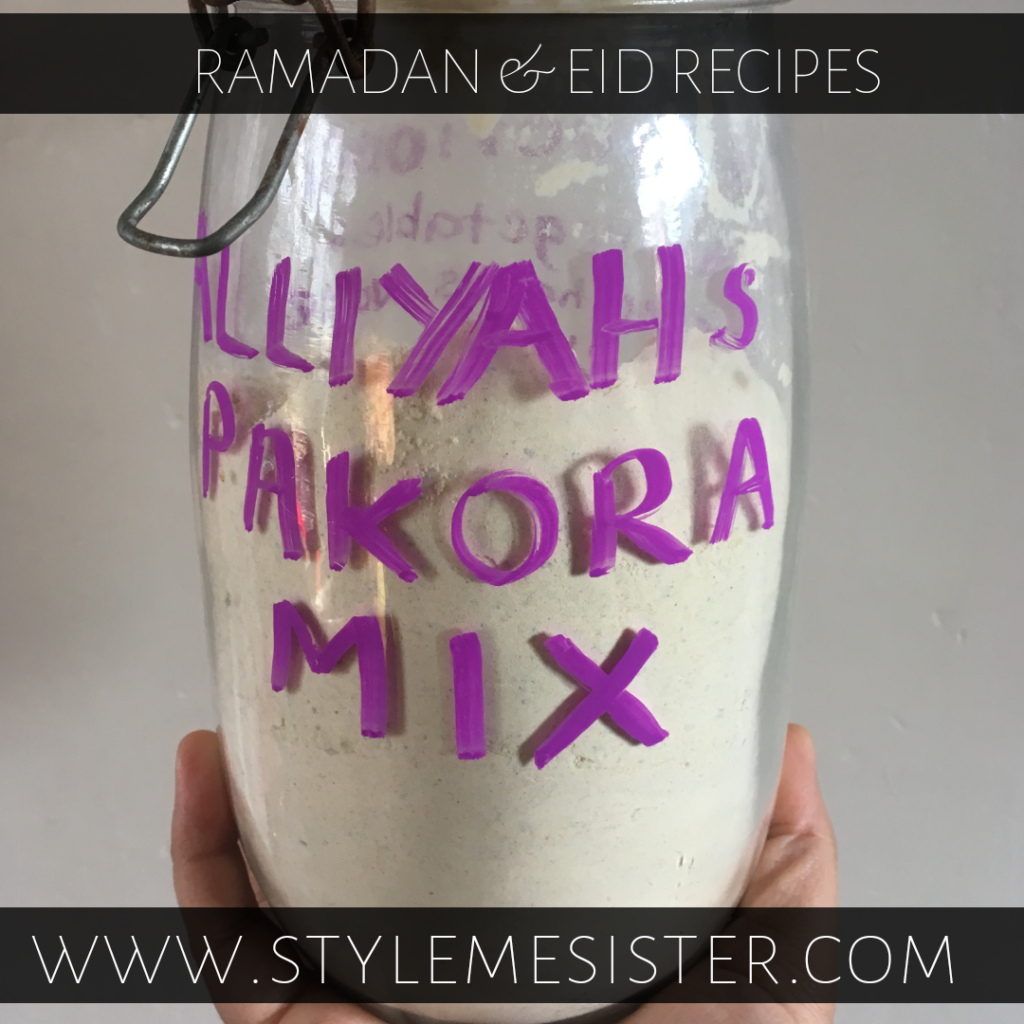
Alliyahs awesome (bulk) Pakora Mix

My bulk Pakora mix

Ramadan Kareem by lovely folk!

For many Asians Pakoras are an essential foodie item on the Ramadan schedule. I’ll admit that as a child I associated these golden nuggets of yumminess with the holy month.

This Ramadan I will be posting recipes I find easy, economical and a bit different to the standard Ramadan feasts we are so used to. And as someone who tries to make healthy eating a part of family life I want to provide recipes I use at home and have tweaked to make them slightly better than the mainstream counterparts. I also like the idea of ‘freestyling’ in the kitchen so I sometimes don’t have exact weights for ingredients just like the average Mama won’t whilst cooking to feed her brood.

I’ll also post shorter articles during the blessed month too. Feel free as always to share the blog posts with your nearest, dearest and folk who love food!

Nowadays I enjoy Pakoras when I want however I know many that spend hours preparing the gram flour mix during the month of Ramadan.

I’m here to suggest that you mix it all in bulk…and cut your work load. Literally!

I make a big batch of Pakora mix to save time and also money. Pre-mixed boxes work out more expensive. The only real convenience they bring to the kitchen is the fact all the spices have been added. That’s it.

Here is my recipe for my Pakora Mix. I’ve made up batches and used them over 2 months so I’ve had no problems at all. I’ve listed the spices I use as standard.

I don’t actually add ‘chili’ in the form of Chili Powder until I’m making a batch of Pakoras. This works for me as I don’t give my daughters lots of chili.

If you are avoiding salt then by all means adjust the recipe to reflect that.

To make a huge batch of Alliyahs Pakora Mix you will need:

4 cups of Gram Flour (that’s chickpea flour aka Basan) sifted into a large bowl
1 TBSP baking powder-sifted into the bowl
2 TBSP salt
1 TBSP dried coriander leaves (heaped)
2 TBSP coriander powder (heaped)
2 TBSP cumin powder (heaped)
2 TBSP carom seeds-whole (heaped)
1 TBSP garam masala powder (heaped)

1) If you haven’t already done it sift the basan (gram flour) and baking powder into a large bowl.
2) Add the spices and stir to eventually distribute the ingredients.
3) Decant the mix into a airtight container.
Your mix is ready to use.

I usually make a test batch of Pakoras so I know if I need to add more spices.

NOTE: to make the Pakora mixture I add 2 TBSP of coriander leaves (finely chopped up) to the mixture.

To use the mix:
There’s two ways I use this mix.

1) Make a thick paste (it should coat the back of a wooden spoon) and dip in your favourite vegetables and deep fry until golden brown.

2) Cut up your vegetables and add 3 tablespoons of the mix. Add a little water and mix to coat the vegetables and create a sticky mix. If the mixture is too gloopy add a bit of water. If you cannot see the Pakora mix and the vegetables are not coated add more mix. It’s a bit of trial and error depending on how much vegetables you are using.

Don’t forget to add some chili powder if you need something a bit more spicy.

Enjoy your Pakoras! What do you usually serve with yours? Drop us a message below.

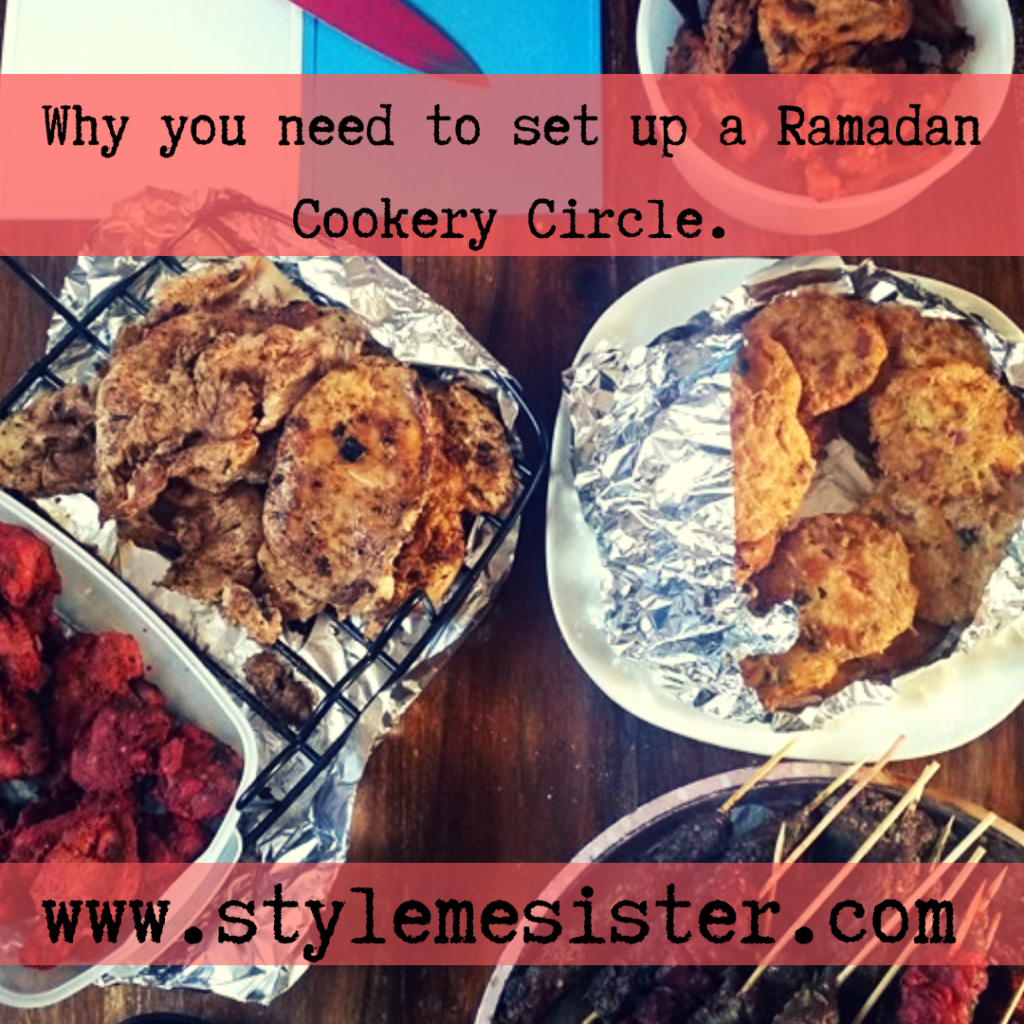
Why you need to set up a Ramadan Cookery Circle

Ramadan is the most blessed months a Muslim can experience. Its a time for contemplation. A time to reflect and change the direction of life. Its a time to give back to charity. It’s a time to get closer to our faith.

Sadly for many sisters its a time where they find themselves chained to the kitchen when they should be reaping the rewards of this awesome month.

For a lot of families food plays a huge part in Ramadan. There’s Sahoor and Iftaars to plan, prepare and cook. Then there’s hosting Iftaars for nearest and dearest (which FYI I haven’t done in a decade). That’s a large chunk of time on a daily basis. By the time you’ve cooked and cleaned up energy levels are at a low and the idea of staying up to repent or pray is near impossible (because half hearted recitation is also a no-no; you want to focus and give it your best).

A couple of years ago I started to batch cook food used in Ramadan and froze it in suitable sized portions. This helped me no end. There was no last minute mad panic in the kitchen. Things ran smoothly; very smoothly.

I then came to the realisation that my issue of balancing the time spent preparing and cooking food with the actual important duties of Ramadan were a problem for a lot of sisters. And if you are reading this and nodding along I have an idea that may help you a lot….

Ladies I present to you the idea of setting up a Ramadan Cookery Circle.

For this idea to work you will need a group of ladies in a similar position to you.

How this works:

Basically you come together with a group of ladies and cook a few recipes in bulk. You then swap portions of the food with others in the circle for food they’ve cooked. And voila; you have instantly increased the amount of food you have for your Ramadan freezer.

Sounds pretty easy doesn’t it? I’ll still talk you through it.

STEP 1:
Gather your friends that will be having the same issue as you during Ramadan together.

STEP 2:
List all the food that you guys know you will be cooking in Ramadan. These foods need to be suitable for freezing.

STEP 3:
List all special dietary requirements including how hot people like spicy foods!
Share recipes (if required) with the group.

STEP 4:
Delegate the recipes out to the group. Agree on how much of each recipe needs to be made.

STEP 5:
Decide when you want the food to be cooked by and where and how the food will be delegated. Will you guys meet up a few days before Ramadan to swap food?

STEP 6:
Take the food home and freeze.

Now that doesn’t seem to be that scary does it?

The idea behind this is you save time by bulk cooking your delegated recipes and then you swap some with the others.

So if there’s 5 of you and you each of you cooked 2 recipes in bulk you are walking away with 10 dishes for your freezer (including what you cook yourself).

Don’t you think that’s awesome?

And the more of you there is there’s potential for less work and more dishes.

In my experience the following are awesome for freezing:

Samosas and rolls
Burrito rolls (great for Breakfasts)
Kebabs/Koftas
Pulaw and Biryani bases
Chutneys
Curry sauces
Meatballs (so pasta sauces, koftas etc).

What else should consider?

How much freezer space you have.
How much time will you need to prepare and cook your dishes in bulk.
Is everyone happy with their delegated dishes.
Do you want to swap dishes or do you want to pay for the ingriedents instead?

The idea of the circle is to cut your time in the kitchen and essentially share cookery skills and invest more time into Ramadan doing things that will be fulfilling.

With Ramadan on it’s way why not share this post with your ladies and see whose willing to sign up to your circle?

Got any advice for other sisters? Drop it below.

Mini Guide to Meal Planning

Stylemesisteradmin
November 12, 2018

Meal planning made easy!

No really; you don’t have to be Martha Stewart of Nigella to carry out successful meal planning.

I bet a lot of you have thought of meal planning and may have even done it and FAILED because of many factors. Some of the main factors that lead to epic maiden voyage failure include:

1) Not considering what your family (and you!) actually enjoy eating
2) Not considering time restraints
3) Not considering budgets
4) Not considering how difficult it maybe to get hold of ‘exotic’ ingredients
5) Not considering fridge and freezer space
6) Not considering family life on the days you are planning meals
7) Not considering the equipment you have at hand
8) Not considering how expensive some pieces of equipment maybe to purchase for a recipe you may not even like

….I could continue but I think I’ve considered the majority of you.

I know exactly how easy it can be to get carried away on pinterest an pin hundreds of lentil meatless balls recipes to a board to try when your family cannot stand lentils. I’ve been there; and that’s why today I will try to demistify meal planning and make it something you CAN do and be successful at.

Let’s dive straight in.

1) BUDGET BUDGET BUDGET
We need to keep this real y’all. How much do you have to spend a week/month. If you have a monthly budget break it down into 4 to see how much you have per week.
TIP: if you really are unaware of food prices log onto a Superstore website and look up prices on the items you’ll be using e.g. meat, pasta, yogurts. I always start by looking at the essential items.

2) How much time do you REALLY have to prepare and cook meals? Do you have a couple hours on a Sunday to prepare for the week ahead? Do you have a block once a month to make a couple of meals you an freeze? Be realistic. We all have lives. You cannot be super wifey, super mama and work long hours and cook organic vegetable lasagna with homemade pasta sheets every day.

NOTE: If you planned to do a bulk preparation session PUT IT IN YOUR DIARY NOW.

So be realistic; go through your diary/plans and look at what time you have on your hands. If your main aim is to eat healthier and you are struggling with time you need to consider freeing up time in your life; after all health is something we cannot put a price tag on.

3) What do you actually enjoy eating? What are your favourite meals? Where do you enjoy eating out?

Make a list of your favourite meals (even the naughtier ones that would give your Doctor a shock).

4) What equipment do you have (or can borrow)?
Do you have a Slow cooker? Maybe a pressure cooker? A panini maker collecting dust?

5) How much fridge and freezer space do you have? Can you brown meat/mince etc for a few days in advance or will you struggle to fit yogurt and milk in?

6) Look up recipes you’ll be using based on the food you enjoy. You may have recipe books. You could also pop into your local Library to borrow some books. Or use the internet.

7) Find a meal planner that works for you. I created my own which has enough space for me to jot down if we’ve got a busy day that day so I don’t over commit to cooking that day.
I keep my Family Calendar on the table as I plan my meals; this helps majorly because I can also see if I need to prepare lunches etc too (which I often use leftovers for).

Note: NOT all the meals I cook are from recipe books. Some are meals I’ve grown up on or use weekly.
You don’t need to try new recipes every single night! That’s going to stress you even more.
If you are an expermental cook set aside maybe two nights a month to try something new. I would ensure you either have leftovers from the night before or a simple meal alternative incase the meal doesn’t go to plan (so maybe the night after a Roast meal. That way you can use leftover roast chicken in tortilla wraps and make cheese and chicken quesadillas and serve them with a dollop of yogurt or sour cream).

Now the fun bit: plan out your meals. I try to make life easier by having rough outlines to what I am aiming to cook on a weekly basis based on what the family eat so I have sub-categories:

Once a week pizza (frozen)
Once a week Pasta dish
Once a week Mince based meal
Once a week Chicken based meal
Once a week Roast chicken meal (with/without all the sides depending on what we fancy)
Once a week fish option
One a week vegetable/lentil based meal

Now some weeks I don’t cook a meal from all those categories but we try our best to vary our diets as it’s important to not get bored with meals and to get as many vitamins, protein etc as recommended.

Some meals cross over more than one category for example:
Chili con carne ‘Shepard’s pie’-it contains mince and a hearty dose of vegetables in the carrot and root vegetable topping. It also contains red kidney beans (lentils=extra protein).

Desi style keema pasta bake: contains pasta and mince chicken. So it’s a pasta dish, contains chicken which is mince.

Notes:
I don’t usually plan lunches UNLESS it’s the holidays as we’re usually busy and I get bored of sandwiches everyday.
I also increase food budgets in holidays because you have extra people around at lunch time.
I also reassess time restraints in holiday lunch planning.

8) Do you shopping after checking what you have in that you will be using.

9) PRINT out your meal plan and keep one on the fridge, one on the family notice board (if you use one) and once in your planner. Whilst you are getting used to meal planning you can do with having gentle reminders.

10) And for the big event itself: get cooking based on your Meal Plan.

What happens next?

Firstly, don’t panic if things don’t go to plan at first. You may have glitches and that’s fine!

Have back up meal ideas if you are trying something you are not sure will go down well with the family (I offer my children toast, beans on toast, spaghetti on toast etc as alternatives to anything they get to fussy with).

NOTE down which meals worked best and which DIDN’T. It’s absolutely fine to cook the same meal a few times a month. It’s also fine to rule out certain dishes too.

Extra useful TIP: I made a list of 7 meals by children and I enjoy and I always include them on the plan. ALWAYS. I also have a Pizza meal night which is Friday’s. I use frozen pizza and that takes away another 3/4 meals a month. That helps me a lot and my girls get their treat too (whilst watching a movie).

Give yourself a pat on the back because getting used to meal planning at first can be very stressful!

I hope that’s helped you somehow: I wish someone had explained to me the basics of meal planning when I first started planning meals and also pointed out that I didn’t have to try something new everyday; and I don’t have to cook anything we don’t enjoy (if your choice is based on nutritious value look for an alterative because in all honesty meal time struggles are not worth the energy lost).