My version of Masala Chai…

Cheats (Easy!) Masala Chai

My fondest memories of time spent with my late Nana was her ordering family to sort breakfast out now rather than at Lunchtime. It was one of pet peeves when folk were lazy and avoided doing things that would inevitably need doing….e.g giving the family Breakfast so everyone can get a move on.

My Nana was old fashioned and she served Parathas, Eggs and old fashioned Desi Tea. Now for those of you unfamiliar with this delicious Asian take on tea let me walk through it.

Desi Tea is basically the standard tea where the tea (loose) has been boiled with water and sugar to cook it out. Milk (lots of it) is then added to the sweet tea mix. The tea is then strained into cups and served hot. Old fashioned folk would pour the tea out into the saucer, blow on it to cool it (epic fail; I mean really. Cooling down boiling milk by blowing on it?). And as a kid I remember tea being the Breakfast drink served with Parathas.

My Nana had a brood of 8 children. It should of been 13 but 5 passed away in infancy.

I on the hand have a small brood (2) and live in England where big Breakfasts with desi tea are not the norm (and before you hit my inbox saying you are upholding your family traditions here in sunny England let me say KUDOS but I am not one of those).

I love spice. I love the warmth of cinnamon, ginger, cardamom….all of them. The spectrum of spices we have available to us would surprise some of my forefathers back in the homeland.

I’m posting this recipe during Ramadan which may seem weird. However I am fully aware that Tea drinkers still like their drinks during the time of Iftar (opening of Fast) and of course Sahoor (closing of fast and commencement of the next fast). Plus I don’t know about you guys but seriously some fasting days leave me feeling cold; so cold I need a hot drink.

Anyhow; if you don’t use the recipe in Ramadan that’s absolutely fine. However if you find yourself hosting Iftars this Tea can be doubled/tripled etc to fit your needs. Plus it is healthier than traditional Desi Chai. We are not using full fat milk; or lots of sugar.

If you traditionally serve Desi Tea on Eid why not give this recipe a go?

Anyhow….when I want a leisurely drink at the weekends I love to opt for this….my take on desi tea with a hit of spice. Masala Tea is also a popular tea in Indian/Pakistan and neighbouring countries. It’s a tea spiced to give you a multi sensory experience. Popular spices used include my favourites (ginger, green cardamom and cinnamon).

This tea can be described as a cup of desi tea meets a latte with a hit of spice. My recipe makes two mugs.

Enjoy.

Ingredients:
400 ml water
150 ml skinned milk
2 standard tea bags (breakfast ones/PG tips/Tetley tea bags….any will do)
1 stick of cinnamon
2 green cardamom pods lightly crushed
1 thin piece of fresh ginger (around 2 cm in length).
Sweetener of your choice

1) Bring the water to a rolling boil. Add the spices and tea bags.
2) Reduce the heat and allow to simmer for three minutes.
3) Remove the spices and teabags carefully from the tea.
4) Bring the water back up to the heat and add the milk. Bring the mixture up the the boil.
5) Simmer gently for 3/4 minutes. Turned the heat off. Gently pour into the mugs.

Your tea is ready.

If you have a milk frothier carefully do your thing and give the tea a bit of fluffiness.

Tip: if you like your tea stronger boil the tea mixture (with the spices in) for longer. This adds to the strength.

Easy Seekh Kebabs…

Healthier than your Takeaway…

There was a time when I would dread making seekh kebabs because I’d struggle with getting the meat to stick to the skewer. Nowadays I’ve learnt a thing or two and and make these kebabs often (as my girls love them and I love the off Kebab Sub).

You can add more/less spices to accommodate your own taste buds.

To make enough kebabs to serve 4…

500 grams mince (I use Mutton however you can use lamb/beef too). Ideally the mince should be ‘marbled’ with fat in other words you can see the fat. If you can’t see any fat you can either ask you butcher to add some (if you use a butcher) or you can spray oil onto the kebabs whilst cooking them.

3 heaped TBSP Coriander leaves and stalks chopped finely
1 medium onion chopped finely
1 heaped TBSP pre-fried onions soaked in warm water for 10 minutes and drained.
3 green chilies chopped finely (or use chili paste)
1 TSP garlic paste
8-12 mint leaves chopped finely
1 TBSP cumin seed powder (heaped)
1 TBSP coriander seed powder (heaped)
Salt-to taste
1 TSP amchoor (green mango powder. It adds a bit of tartness)
OPTIONAL: liquid smoke flavouring

Wooden skewer sticks. If you are going to cook these kebabs on the BBQ soak the wooden skewers to avoid them catching fire.

1) Place all the ingredients in a large bowl.
2) With your hands mix the mince thoroughly.
3) Divide up the mixture into equal portions. You want to make long sausage shape skewers but thinner than the average banger.
4) Wet your hands and take the mince into one of your hands. Now shape it around the skewer. The mixture should be tightly packed around the skewer to stop it falling apart.
5) Cover the kebabs with cling film and place in the fridge for at least 30 minutes.
6) Now you will either shallow fry or BBQ the kebabs. If you are shallow frying take a large pan and heat it on a medium heat. Fry a few kebabs at a time. Turn over and fry until the kebabs are golden all over.
7) Drain on kitchen paper.
8) Serve your Kebabs with your choice of chutneys and sauces.

NOTES:
These kebabs can be frozen successfully for up to 3 months. To freeze cook the kebabs, cool them completely and freeze them open on a baking tray for an hour. Then transfer the kebabs to a airtight container of bag.

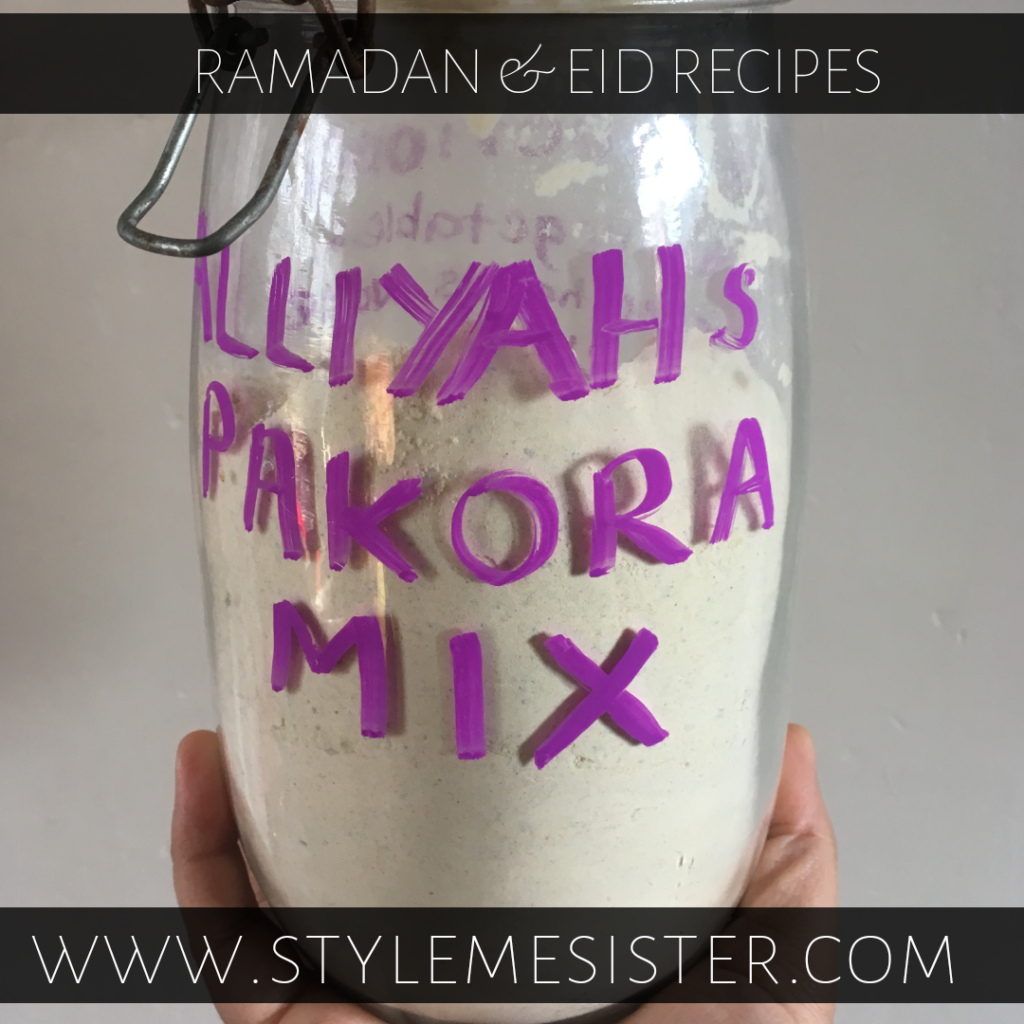
Alliyahs awesome (bulk) Pakora Mix

My bulk Pakora mix

Ramadan Kareem by lovely folk!

For many Asians Pakoras are an essential foodie item on the Ramadan schedule. I’ll admit that as a child I associated these golden nuggets of yumminess with the holy month.

This Ramadan I will be posting recipes I find easy, economical and a bit different to the standard Ramadan feasts we are so used to. And as someone who tries to make healthy eating a part of family life I want to provide recipes I use at home and have tweaked to make them slightly better than the mainstream counterparts. I also like the idea of ‘freestyling’ in the kitchen so I sometimes don’t have exact weights for ingredients just like the average Mama won’t whilst cooking to feed her brood.

I’ll also post shorter articles during the blessed month too. Feel free as always to share the blog posts with your nearest, dearest and folk who love food!

Nowadays I enjoy Pakoras when I want however I know many that spend hours preparing the gram flour mix during the month of Ramadan.

I’m here to suggest that you mix it all in bulk…and cut your work load. Literally!

I make a big batch of Pakora mix to save time and also money. Pre-mixed boxes work out more expensive. The only real convenience they bring to the kitchen is the fact all the spices have been added. That’s it.

Here is my recipe for my Pakora Mix. I’ve made up batches and used them over 2 months so I’ve had no problems at all. I’ve listed the spices I use as standard.

I don’t actually add ‘chili’ in the form of Chili Powder until I’m making a batch of Pakoras. This works for me as I don’t give my daughters lots of chili.

If you are avoiding salt then by all means adjust the recipe to reflect that.

To make a huge batch of Alliyahs Pakora Mix you will need:

4 cups of Gram Flour (that’s chickpea flour aka Basan) sifted into a large bowl
1 TBSP baking powder-sifted into the bowl
2 TBSP salt
1 TBSP dried coriander leaves (heaped)
2 TBSP coriander powder (heaped)
2 TBSP cumin powder (heaped)
2 TBSP carom seeds-whole (heaped)
1 TBSP garam masala powder (heaped)

1) If you haven’t already done it sift the basan (gram flour) and baking powder into a large bowl.
2) Add the spices and stir to eventually distribute the ingredients.
3) Decant the mix into a airtight container.
Your mix is ready to use.

I usually make a test batch of Pakoras so I know if I need to add more spices.

NOTE: to make the Pakora mixture I add 2 TBSP of coriander leaves (finely chopped up) to the mixture.

To use the mix:
There’s two ways I use this mix.

1) Make a thick paste (it should coat the back of a wooden spoon) and dip in your favourite vegetables and deep fry until golden brown.

2) Cut up your vegetables and add 3 tablespoons of the mix. Add a little water and mix to coat the vegetables and create a sticky mix. If the mixture is too gloopy add a bit of water. If you cannot see the Pakora mix and the vegetables are not coated add more mix. It’s a bit of trial and error depending on how much vegetables you are using.

Don’t forget to add some chili powder if you need something a bit more spicy.

Enjoy your Pakoras! What do you usually serve with yours? Drop us a message below.

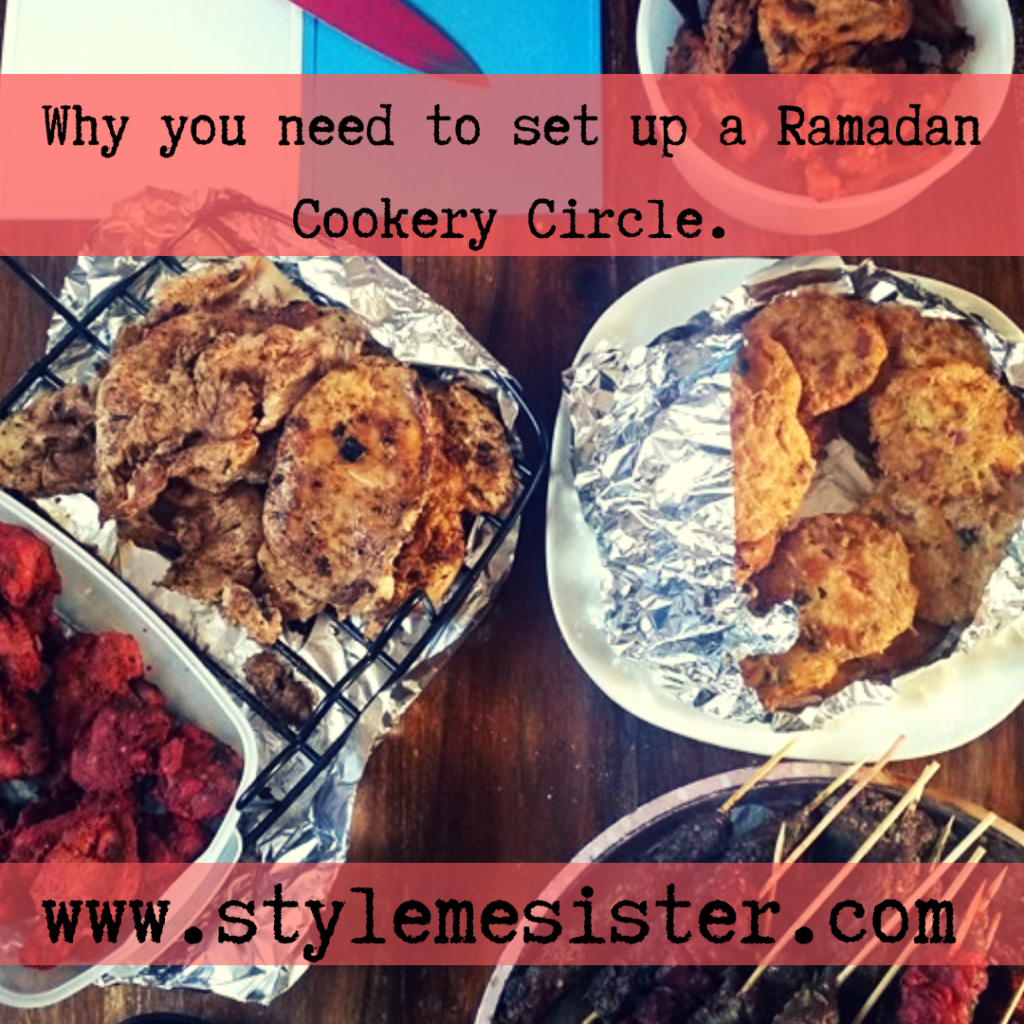
Why you need to set up a Ramadan Cookery Circle

Ramadan is the most blessed months a Muslim can experience. Its a time for contemplation. A time to reflect and change the direction of life. Its a time to give back to charity. It’s a time to get closer to our faith.

Sadly for many sisters its a time where they find themselves chained to the kitchen when they should be reaping the rewards of this awesome month.

For a lot of families food plays a huge part in Ramadan. There’s Sahoor and Iftaars to plan, prepare and cook. Then there’s hosting Iftaars for nearest and dearest (which FYI I haven’t done in a decade). That’s a large chunk of time on a daily basis. By the time you’ve cooked and cleaned up energy levels are at a low and the idea of staying up to repent or pray is near impossible (because half hearted recitation is also a no-no; you want to focus and give it your best).

A couple of years ago I started to batch cook food used in Ramadan and froze it in suitable sized portions. This helped me no end. There was no last minute mad panic in the kitchen. Things ran smoothly; very smoothly.

I then came to the realisation that my issue of balancing the time spent preparing and cooking food with the actual important duties of Ramadan were a problem for a lot of sisters. And if you are reading this and nodding along I have an idea that may help you a lot….

Ladies I present to you the idea of setting up a Ramadan Cookery Circle.

For this idea to work you will need a group of ladies in a similar position to you.

How this works:

Basically you come together with a group of ladies and cook a few recipes in bulk. You then swap portions of the food with others in the circle for food they’ve cooked. And voila; you have instantly increased the amount of food you have for your Ramadan freezer.

Sounds pretty easy doesn’t it? I’ll still talk you through it.

STEP 1:
Gather your friends that will be having the same issue as you during Ramadan together.

STEP 2:
List all the food that you guys know you will be cooking in Ramadan. These foods need to be suitable for freezing.

STEP 3:
List all special dietary requirements including how hot people like spicy foods!
Share recipes (if required) with the group.

STEP 4:
Delegate the recipes out to the group. Agree on how much of each recipe needs to be made.

STEP 5:
Decide when you want the food to be cooked by and where and how the food will be delegated. Will you guys meet up a few days before Ramadan to swap food?

STEP 6:
Take the food home and freeze.

Now that doesn’t seem to be that scary does it?

The idea behind this is you save time by bulk cooking your delegated recipes and then you swap some with the others.

So if there’s 5 of you and you each of you cooked 2 recipes in bulk you are walking away with 10 dishes for your freezer (including what you cook yourself).

Don’t you think that’s awesome?

And the more of you there is there’s potential for less work and more dishes.

In my experience the following are awesome for freezing:

Samosas and rolls
Burrito rolls (great for Breakfasts)
Kebabs/Koftas
Pulaw and Biryani bases
Chutneys
Curry sauces
Meatballs (so pasta sauces, koftas etc).

What else should consider?

How much freezer space you have.
How much time will you need to prepare and cook your dishes in bulk.
Is everyone happy with their delegated dishes.
Do you want to swap dishes or do you want to pay for the ingriedents instead?

The idea of the circle is to cut your time in the kitchen and essentially share cookery skills and invest more time into Ramadan doing things that will be fulfilling.

With Ramadan on it’s way why not share this post with your ladies and see whose willing to sign up to your circle?

Got any advice for other sisters? Drop it below.

70 days left until Ramadan 2019…

70 DAYS until we are greeted by the holiest month of the Islamic year. As promised here is a breakdown of goals I am setting to get best out of Ramadan.

Life & Spirituality:

Break down your responsibilities over Ramadan and sort out your time table for the Holy month. Then you can plan your time WISELY. But the first step is to sort out your calendar/dairy.

Ideally you only want to keep the responsiblities that cannot be moved or take a back burner until post Ramadan.

These in my opinion are:
Work, responsibilities towards family (School runs etc), College/Education and of course your development as a Muslim (prayers, meditation etc).

For some these may include community volunteering and even the gym. But you get the idea.

What can be delayed/moved?
Meeting up with friends, sleep overs for the children, other social events, binge watching box sets…you get the picture.

Knowing how much time you have to commit to Ramadan activities exclusively will help you map out what you want to achieve better. It helps me not over commit and under achieve.

Long fasts….Iftaar parties are so tiring….

As Ramadan 2019 is during the hotter months (with a long day) organising Iftaars is a lot of work and can be very tiring.

  • Instead of organising Iftaars consider the following:
  • Donating food to a Food Bank
  • Volunteering the time to a Soup Kitchen
  • Send a Food Hamper to close family
  • Send cookies/Fruit platters for Iftar to friends (you can bake the cookies with children before Ramadan and package them and distribute them on the first of Ramadan).
  • Send a box of dates. We actually do this. We also send ‘fancy a date’ cones to the School for the Teachers. It’s a nice gesture and includes those that are around your children for such a long period of time to enjoy some of the festivities too.

So what are your goals for Ramadan? Why not leave us a comment below and inspire others too.